STAR-VF: Spatio-Temporal Aware Representation Condensation
for Data-Efficient Video Fusion
Abstract
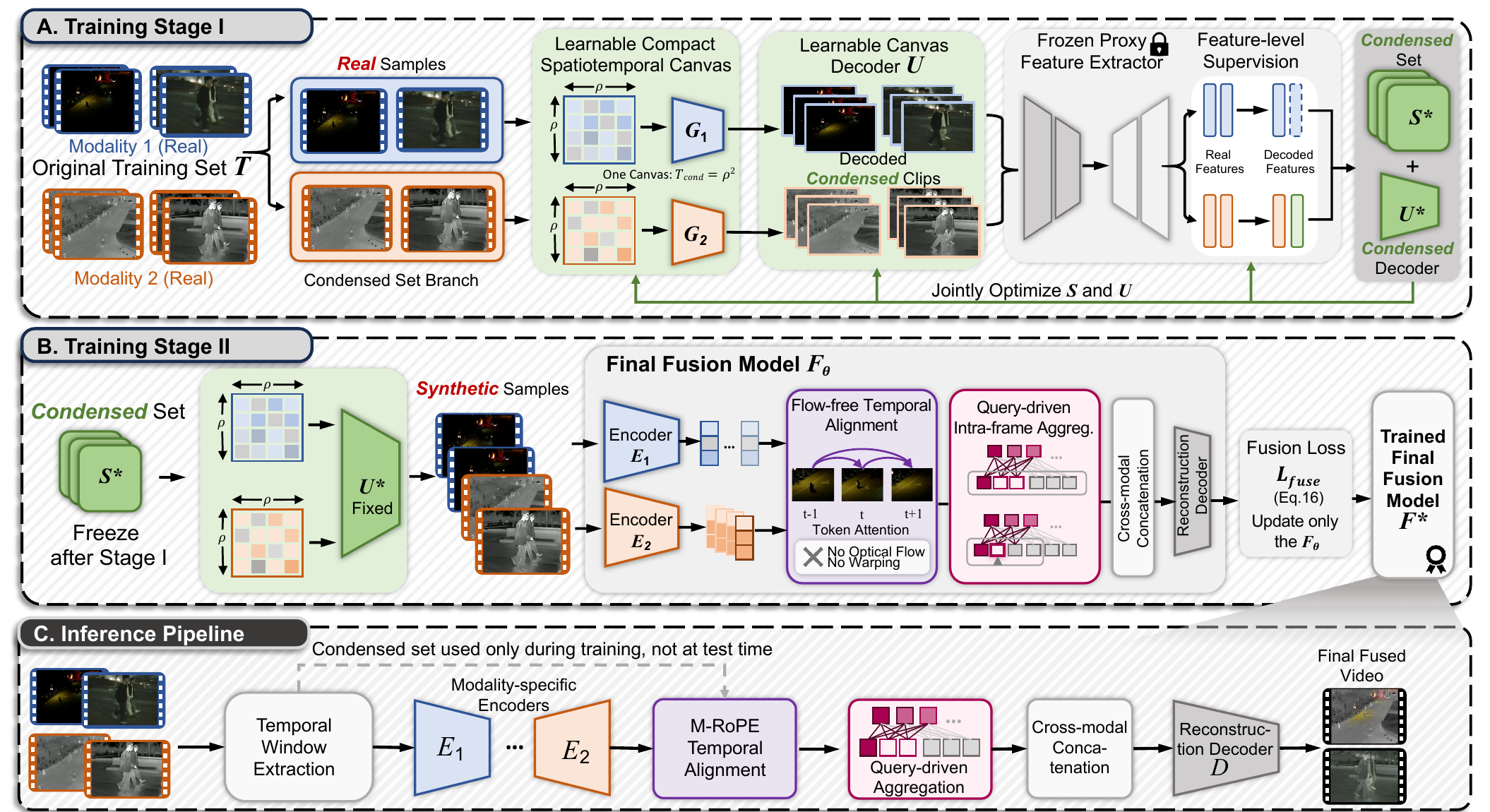
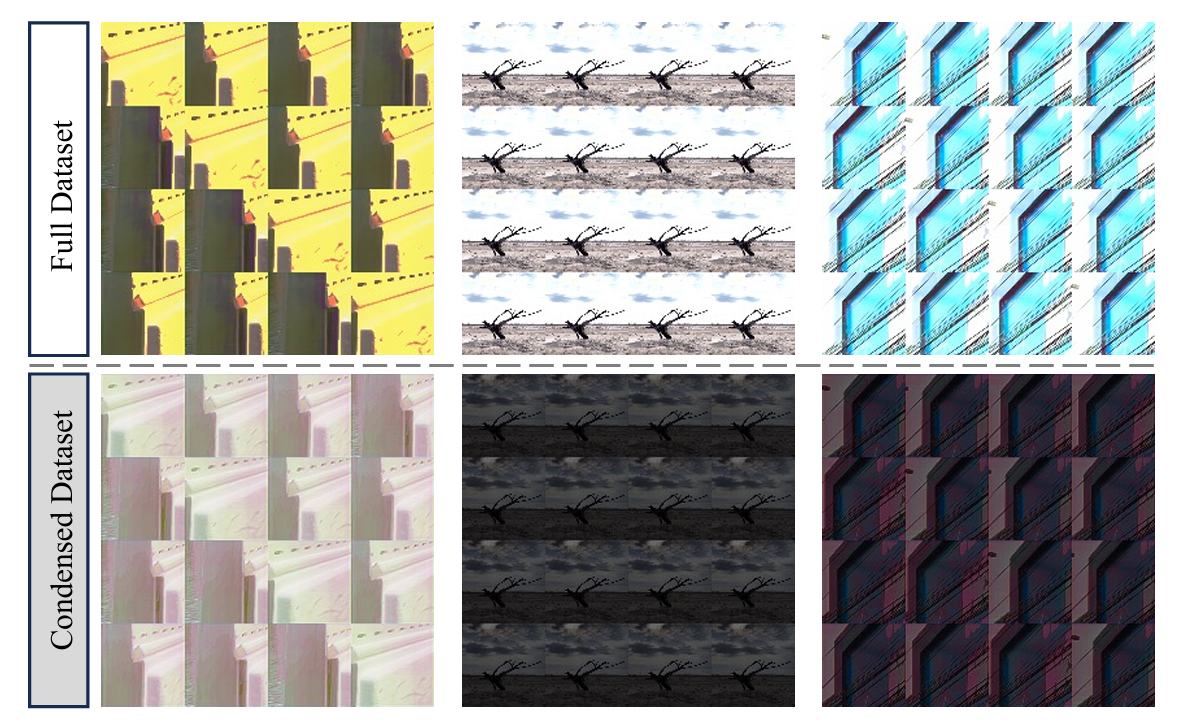
Video fusion aims to integrate complementary cues from heterogeneous sources, producing visually informative videos with coherent spatio-temporal structures. Jointly learning cross-modal complementarity and temporal dependencies typically relies on large-scale, high-quality video datasets, whose storage and repeated use during optimization incur substantial costs, making data-efficient learning highly desirable. To address this challenge, we rethink video fusion from the perspective of dataset condensation and propose STAR-VF, the first framework that condenses spatio-temporal representations for data-efficient video fusion. STAR-VF condenses the original training set into a compact set of learnable spatio-temporal representations, which are decoded into synthetic video clips and optimized using feature-level supervision provided by a frozen proxy model. The resulting condensed data preserves fusion-relevant spatial and temporal cues without requiring ground-truth fused videos as supervision. To adapt fusion learning to condensed representations, we equip the final fusion model with flow-free inter-frame temporal modeling and query-driven intra-frame aggregation, enabling direct temporal interaction and adaptive selection of fusion-relevant information in representation space. Extensive experiments on infrared-visible, multi-exposure, multi-focus, and medical video fusion benchmarks demonstrate that STAR-VF, trained with only approximately 1/16 of the original temporal training set, achieves fusion quality comparable to methods trained on the full data. Further analyses validate the contributions of learned condensation and flow-free temporal modeling, and demonstrate the robustness of the condensed supervision across different proxy encoders and downstream fusion models.
Method Overview
Experiments
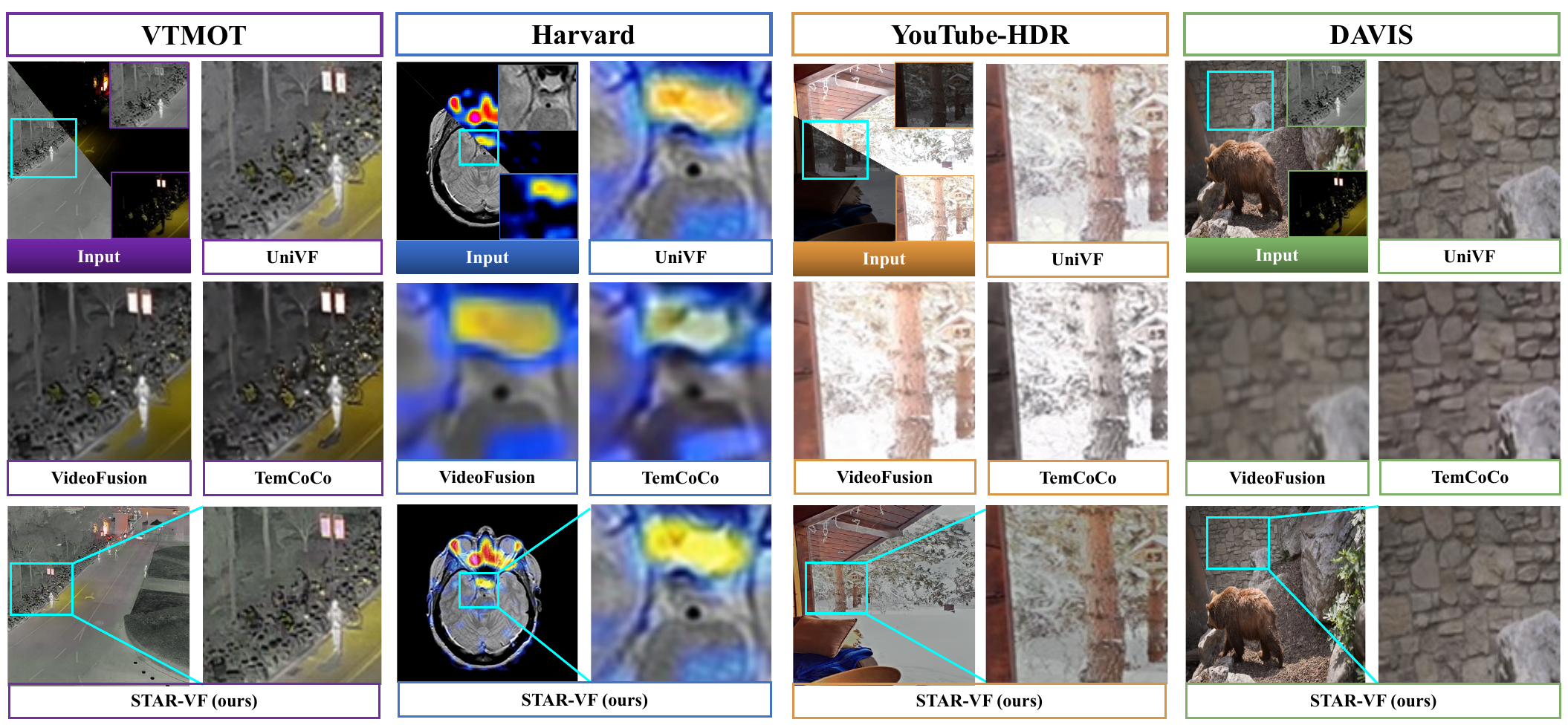
We evaluate STAR-VF on four representative video fusion tasks using established benchmark datasets:
- Infrared-visible video fusion (IVF): evaluated on VTMOT.
- Medical video fusion (MVF): evaluated on Harvard.
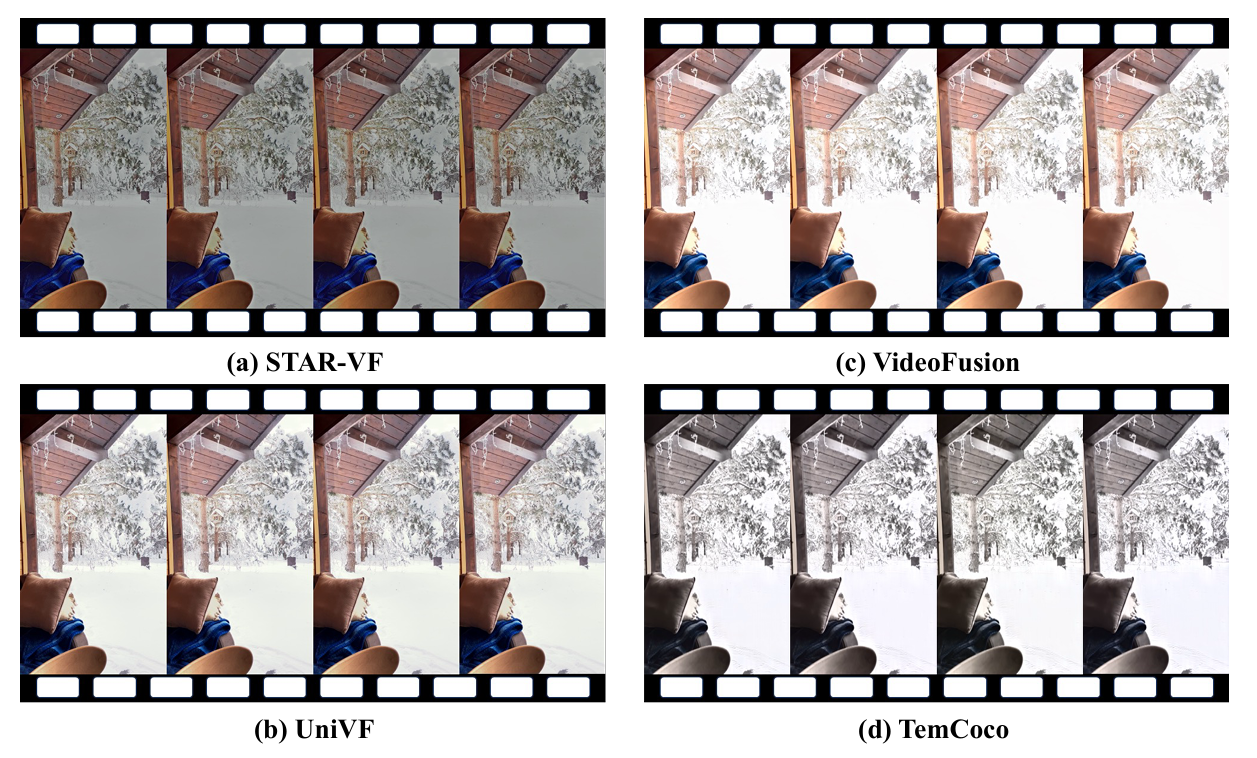
- Multi-exposure video fusion (MEF): evaluated on YouTube-HDR.
- Multi-focus video fusion (MFF): evaluated on DAVIS.
We compare with state-of-the-art video fusion methods, including UniVF, VideoFusion, TemCoCo, and MambaVF, using both fusion quality and temporal consistency metrics. STAR-VF achieves competitive overall performance while substantially reducing the training data and inference cost, showing that the learned compact source preserves the spatial and temporal information required for video fusion.
BibTeX
@inproceedings{xian2026starvf,
  author    = {Xian, Yuchen and Xu, Yunqiu and Lin, Guosheng and He, Yang},
  title     = {STAR-VF: Spatio-Temporal Aware Representation Condensation for Data-Efficient Video Fusion},
  booktitle = {Proceedings of the 34th ACM International Conference on Multimedia},
  series    = {MM '26},
  year      = {2026},
  address   = {Rio de Janeiro, Brazil},
  numpages  = {8},
  publisher = {Association for Computing Machinery}
}